
Late last year, I toured North Dakota’s maximum-security prison in Bismarck. If you didn’t know that or would like a refresher, click here for the story that prompted my dad to email, “I liked your article. It was a bit longer than usual, wasn’t it?” It was; I’d describe it as “thorough.” This story that you’re reading right now will be less thorough, but I would still go to the bathroom and get a cup of coffee because we’ll be together for a bit.
The North Dakota Department of Corrections and Rehabilitation (DOCR) differs from many of the prison systems in the country in how it approaches rehabilitation. As I wrote previously, there are people who will never choose anything but the path of trouble, and no amount of therapy or education or job training or mentorship or even punishment will rehabilitate that, The End. But there are also human beings who can use their time in prison for good. What do I mean by “good?” Feeling remorse for their actions. Making change for themselves. Help others make change. Providing value instead of just eating up resources. Repaying their debts to society. Behaving appropriately in prison to keep themselves and the staff safe. The DOCR passionately believes, and has proven, that their rehabilitation programs are necessary to helping their residents choose a long-term path towards “good.”
To our state’s taxpayers, the most important “good” a resident can do by the end of their sentence is to leave prison and never come back. Felons are entering the North Dakota State Penitentiary at an average of 30 people per week and there’s never been a newspaper headline to the effect of “Go commit a crime because the DOCR has tons of room and is rolling around in money.” Economically, the biggest benefit of rehabilitation is that it reduces recidivism. According to reports by the U.S. Department of Justice and the National Bureau of Economic Research, inmates who participate in rehabilitative education and workforce programs cut the likelihood of reoffending by 43-46%, and for every $1 spent on related prison programs taxpayers save $4-5 on the costs of reincarceration.
Which brings us to Rough Rider Industries (RRI).
As you know from my previous story, the foundation of the DOCR’s rehabilitation efforts is to get its residents educated and get them to work. Eighty-nine percent of the residents are employed within the prison proper as cooks, tutors, janitors, librarians, and the like. The other 11% are employed by Rough Rider Industries, the self-sustaining Correctional Industries division located on the prison grounds. What is Correctional Industries? In brief, Rough Rider Industries is a business which employs both residents (170) and outside staff (32) and covers 100% of its own employment, operational, supplies, equipment, and maintenance costs with the revenue generated from the sale of its products.
“We use zero taxpayer dollars, and the work we do here gives back over and over again to North Dakota,” Rick Gardner, the Director of Rough Rider Industries told me. “We’re giving our residents the skills they need to keep them out of prison, we’re building quality products, we’re keeping money in North Dakota by using local vendors for our materials, and we are a solution to North Dakota’s workforce shortage.”
Rick is Rough Rider’s most passionate and proudest champion – “These guys are so creative and do such good work,” he said as he pointed out a piece of art one of the residents crafted from scraps during his breaks – although it did not start out that way when he came into the role 15 years ago.
“I was running my own business and got burned out trying to find employees during the oil boom and so I took this job for a break,” he said. “I had the same stereotypes as anyone, but once I got to know and see the true people behind our residents and see what Rough Rider could do for them and for everyone else, it brought out the compassion in me. It changed me.”
When I first told my family, friends, neighbors, coworkers, restaurant servers, grocery store checker-outers, gas station attendants, and random strangers on the street that I would be touring Rough Rider Industries, they collectively said the same thing:
“Oh, yeah, license plates.”
They were right; Rough Rider Industries was established in 1975 and has produced North Dakota’s license plates (the prison has manufactured plates since 1934). In fact, they send 30,000 plates in 231 different designs out the door each month, all of which are created by a resident named Owen (his favorite is the blackout, in case you were wondering). They also do a lot, a LOT more than that. Giddy up.
I knew generally what I was getting into with Rough Rider from my last visit – “We couldn’t keep you out of prison, huh?” my tour guides said when I walked in because the DOCR is solid in the jokes – but I didn’t know the scale of what I was going to see until we entered the first of the three giant buildings at the State Penitentiary…which were only a portion of the total facilities and products Rough Rider operates out of three DOCR sites. The James River Correctional Center, a medium-security prison, makes clothes and plastic bags, upholsters chairs and seating products, and distributes the prison commissary. The Missouri River Correctional Center, a minimum-security prison, manufactures sandbags, welds ag-related products, and manages farming and grazing land. They also do the delivery and install for all of the prison products. And, at the State Penitentiary, they build furniture, fabricate metal, and engrave things like badges, plaques, signs, and other wood items.
If you’re thinking, “Hey, some of those things go together,” you’d be right. For example, the woodworking department had finished wooden chair lounger frames for the furniture for North Dakota’s upcoming new women’s prison while I was there. Once complete, they will be delivered to Jamestown to be upholstered.
Also, if you’re thinking, “Hey, that’s a lot of stuff; I wonder if I’ve ever seen a product made by these guys?” Chances are, yes. Rough Rider can only sell to the government, non-profits, and a few authorized retailers but their craftsmanship is everywhere. Ever been to the North Dakota Heritage Center? Rough Rider did the fossil and dinosaur displays. Did you graduate from the University of Mary? They made your plaques. Put your clothes in a sports locker at Bismarck State University? Rough Rider. Read a street sign or sit at a picnic table at a state park or throw away something in a dumpster at a government or non-profit property? That’s them, too.
“You really need to stamp your work with ‘Made in North Dakota,’” I told Rick. “Or at least ‘Rough Rider Industries.’”
“Our people are our product,” he said. “We used to say we want to help our residents get into jobs, but now we really focus on building careers for when they leave.”
When it comes to careers, Rough Rider does more than skill training.
“A lot of the guys have never held a 9-5, and so we try to make it as job-like as possible with a job interview, a regular schedule, performance reviews, and presentation training so there aren’t any surprises when they are released,” Rick said.
To that end, the residents, and not the staff, showed me around Rough Rider Industries. My first tour guide, Zach, shook my hand and let me know I was his first tour ever (he did great, by the way). Zach started out as the prison librarian before moving to welding and then CNC fiber laser cutting.
“I worked for Ford for 10 years as a Certified Mechanic, so CNC was new for me,” he said, showing me the high-tech machine he was using to cut out the parts for an aluminum frame. “One of the guys left and so I applied for this job and learned how to use and maintain the equipment. It’s cool, I like it.”
“This is the same equipment that the big companies in North Dakota use,” Rick told me. “We’ve had leadership from these companies come through on the tour and tell our residents they will have a job for them when they get out.”
The blueprints for Zach’s project, along with every project at Rough Rider, were generated in the design shop – a group of eight residents tucked away in cubicles clicking away in AutoCAD and Inventor.
“The sales guys sketch what they want and these guys make it happen,” Rick said. “They don’t have internet access so they can’t just look something up on Google, so they like anything that is challenging or unique the best because they have to figure out how to make it work.”
“Technology is our greatest challenge,” he continued. “Imagine being someone who has spent 30 years in the system and is released and we say to him, ‘There you go, don’t come back now.’ It’s very important we train them in modern technology so they can integrate back into society.”
Ron, a resident designer, was working on the blueprints for an office desk.
“It’s cozy in here,” I said, noting the tight size of the design shop.
“We’re used to being this close together,” Ron said. “We work together and live together and we spend all of our time together. And we hang out even when we don’t have to hang out.”
“What happens if you have a disagreement?” I asked.
“We gotta work it out,” Ron said. “But we all get along.”
Zach moved us on to the welding department. Resident and shop mentor, Jon, was putting together a prototype of a metal locker with another resident. Their workplace supervisor – who, like Rick, did not come to the prison with any prior experience in corrections – stood off to the side.
“We build one side, perfect one side, and then clone it,” Jon told me. “And repeat.”
“I don’t want to brag,” I bragged to Jon and Zach, “but I welded a pretty awesome Snoopy sign in high school Tech Ed. Pretty. Awesome.”
“Anyone can weld,” he told me.
After we finished laughing, he continued, “It’s true, anyone can weld. There have only been two people I wasn’t able to teach in here and I’ve been doing this for a long time.”
Jon and his fellow resident were using hand tools to assemble the locker. While Rough Rider feels very much like a busy manufacturing facility and very little like a prison – most of the COs wear regular clothes instead of uniforms – it’s still a prison and the tools are heavily controlled.
“If you look back at escape attempts across prisons, they involve tools,” Rick said. “So every tool here is checked out by resident number, and every tool is coded and shadowed by risk level in its spot so we know immediately if anything is missing.”
“Have you ever had a Rough Rider resident try to escape?” I asked.
“Not as long as I’ve worked here,” he said.
Zach showed me around the rest of the departments, where residents were busy grinding, cutting, and assembling huge sheets of metal. At the back of the building, a cluster of dumpster lids were waiting their turn for the one-hour trip through the powder coating system, which I can only describe as a high-heat car wash-type conveyor system. The powder coater was old, Zach told me, and preparing to be replaced.
“Even though we are 100% self-funded we are still a state agency and are given budgeted spending authority by the legislature on how much we can spend every year,” Rick told me, “So we need to anticipate replacing machinery and equipment like HVAC on a schedule so as not to overspend. Our next big purchase will be replacing our metal coatings application to include a wet paint booth and powder coating application line.”
After an hour in metals in which I learned things like 10-yard dumpsters have to be built vertically because there isn’t enough room to keep them horizontal, we left that building and moved on to furniture. While the metal manufacturing building smelled like sparks and paint, the furniture manufacturing building smelled like cut wood. Having said goodbye to Zach, my new tour guide was a resident named Nathan. Nathan worked at his own construction company prior to incarceration; when he came to the prison, he went right into Rough Rider Industries as a shop mentor.
“If you have to be in here, this is a better use of your time than anything else,” Nathan told me. “Believe it or not, this was actually the first W-2 I’ve ever signed.”
Similar to the metal manufacturing building, operations in wood fabrication ran with the efficiency of a commercial shop. As the residents cut, sanded, stained, and assembled products – one of the big projects on the floor was 329 solid oak hymnal racks and kneelers for a Catholic church in Bismarck – Nathan demonstrated equipment like an Austrian-made car-sized lamination table where laminate was glued onto a wooden substrate. On the walls, the residents had nailed up sheets of printed paper slipped into three-ring binder sleeves showing off some of their past work.
“We don’t usually get to see the final product in place,” Nathan said. “Not just because we can’t leave, but because a lot of our stuff goes to Jamestown to be upholstered and so we don’t see it completed, just like the guys over in metal fabrication don’t see what we do after they send it over to us. We’re always happy when people send us pictures.”
Similar to the metal manufacturing building, the residents’ art was on display throughout the facility.
“We had a slowdown in work a few years ago and we didn’t want to lay guys off,” Rick told me, “So we had them design and build custom birdhouses. We originally were going to sell them at the front [as an aside, the prison lobby has a small case of resident-made art for sale] but they turned out so nice that the Heritage Center put them in their gift shop. One of our residents made his into teepees. They were all unique, and they all sold out.”
“Why did you have a slowdown in work?” I asked.
“Well, these guys have a high level of craftsmanship and build to last so it’s not great for business,” he joked. “Usually the style wears out before the product so if we ever need to replace something, it’s for looks and not wear.”
“You really need to stamp your work with ‘Made in North Dakota,’” I told Rick for the 150th time.
“Our people are our product,” he repeated to me for the 150th time. “I just had a former resident come back and visit. He was a gang member who spent 17 years in prison. This was a guy that you didn’t think you could get through to, but he took to the work and the experience at Rough Rider and used it to better himself. When he got out he started his own upholstery business, and he came back to tell me he owed everything to Rough Rider. I told him he didn’t owe us anything; he took the opportunity given to him and changed his life.”
“That’s success at Rough Rider Industries.”
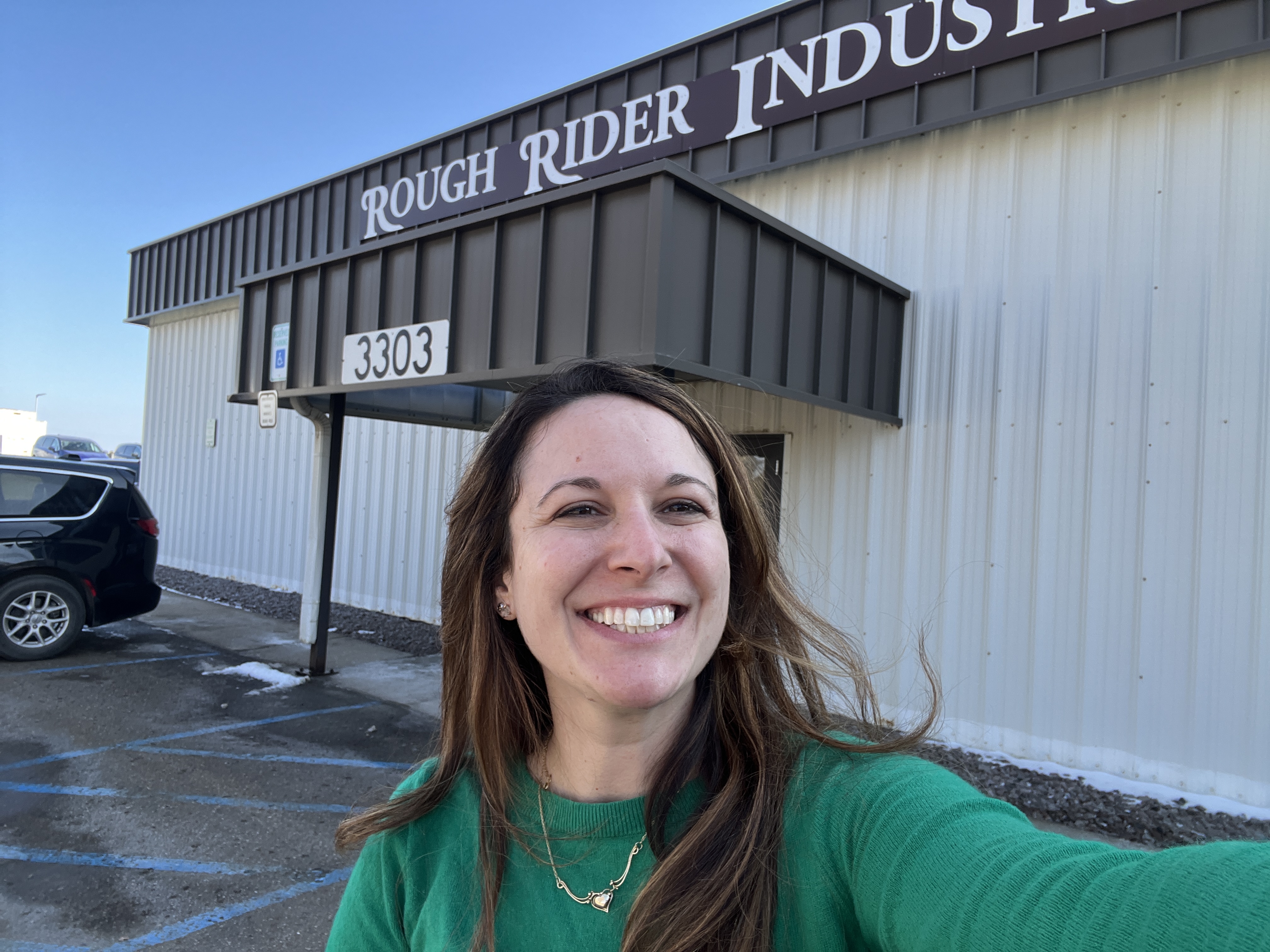
I didn’t even talk about the fact that Rough Rider Industries has a showroom where the salespeople work. It’s also where the gathering point for all of the deliveries. The photo above is of me standing in front of the RRI showroom, which is located just outside of the prison grounds.
This week on North Dakota Today, we talked about Andrew Krauseneck and his Uncle Mark, my Nice People of the Week, as well as a group helping foster kids bridge the gap between home and school. (Valley News Live)
One of my favorite things about living in North Dakota how most of the newspapers print birthday announcements. (Minot Daily News)
Inspired to help formerly-incarcerated North Dakotans with their reentry? Check out what F5 and the Bread of Life Lutheran Church are serving up for dinner. (KFYR TV)
Raise your hand if you know a North Dakota middle schooler who was stuck in New York or Washington D.C. last week. Here is one story of the community getting them home. (KFYR TV)
The Williston Community Library is now home to the Adrienne Stepanek Historical Archive Room in honor of the library’s “ray of sunshine.” (Williston Herald)
Need a fun fact to wow people at parties? Al Jolson got his start in Fargo. (Fargo Forum)
Remember FAARMS from North Dakota Today? Mentorship applications open May 1. (Minot Daily News)
Welcome to North Dakota, Beau. (Police 1)
Congratulations to Clint Gilbertson, North Dakota’s Fire Instructor of the Year. (Grand Forks Herald)
Leave a Reply