
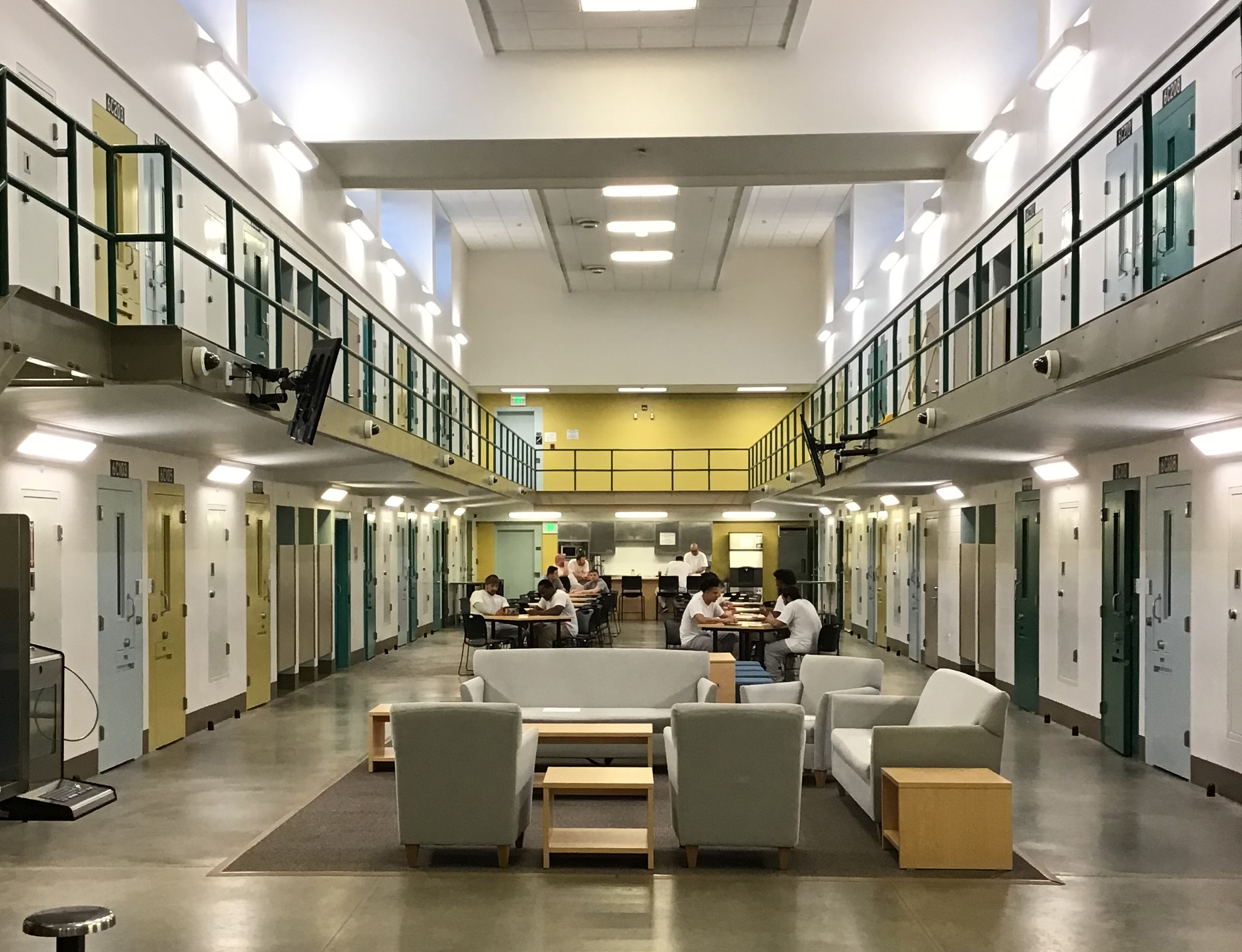
A couple of months ago, a North Dakota Today viewer sent me a link pointing to the North Dakota Department of Corrections and Rehabilitation (DOCR)’s Facebook page.
“Check out what they are doing in the community,” the viewer wrote, referencing several posts in which the DOCR’s residents and staff served food at the homeless shelter, cleaned up one of the animal pens at the local zoo, and packed meals for Feed My Starving Children. “I hope you like it enough to put it on TV.”
I did like enough to put it on TV. Later that week, Kayli Richards, the Director of Communications for the DOCR, emailed me.
“Would you ever be interested in touring the North Dakota State Penitentiary?” She wrote, noting the men’s maximum-security prison in Bismarck. “I’d love to tell you so much more.”
“HARD YES,” I replied, followed by a bunch of fist-pump emojis (except that I actually wrote back something professional like, “Okay.” so that I didn’t scare her away).
Prior to my tour of the prison, I did not think about prison. I’m not a true crime junkie, I don’t watch police shows, I don’t listen to a lot of Johnny Cash, and so on and so on. One hundred percent of my “Oh, right, prison” thoughts came whenever the movie The Shawshank Redemption was on TV or when I saw a bag of Hot Cheetos because one of my junior high classmates was incarcerated for a period of time and shared post-release her recipe for prison ramen (make and drain the ramen, stir in ramen seasoning packet and crushed Hot Cheetos, eat; pretty good).
With that said, I did know a little bit about the North Dakota Department of Corrections and Rehabilitation beyond what I shared in my North Dakota Today segment because North Dakota’s corrections system is different from much of the country – specifically around the word “Rehabilitation.” In one sentence (pun not intended), the “North Dakota Way of Doing Things” focuses on rebuilding felons into contributing members of society, even if those felons never leave the prison walls. As you can probably imagine, people have strong feelings about that.
I’ve had the luxury of being able to form my opinion on the matter as someone completely outside the system. I’m not incarcerated (knock on wood). I’m not a victim (knock, knock on wood). I’m not a family member of anyone associated with corrections, I don’t work or volunteer in corrections, and I live about as far away as someone can live from the jail in Grand Forks. I’m the person who gets a free ticket to a baseball game, pulls into the loading dock, grabs a complimentary hot dog and game ball, and drives away.
Because of that, and before I get into my actual tour of the prison, I want to be clear about my overall opinion of incarceration-related rehabilitation so that you can think, “Amanda, you idiot” and click away if you so choose.
Prison is not nice; it’s prison. I spoke with several of the residents in the State Penitentiary and absolutely no one said, “I love it here; more prison!” I asked them if they had a message for me to share with you fine folks and everyone had a variation of the same two things: Stay out of trouble, and stay out of prison.
There are definitely bad people who will never be anything but bad people, and no amount of mentorship or education or treatment or even punishment will fix that, The End. But there are also people who can use their time in prison for good. What do I mean by “good?” Feeling remorse for their actions. Making change for themselves. Help others make change. Providing value instead of just eating up resources. Getting the tools they need to stay out of trouble once released. Or, more baseline, behaving appropriately in prison to keep themselves and the staff safe. Despite my limited knowledge, I have a hard time believing that a system designed only to incarcerate is somehow equal in its results in those areas to a system designed to rehabilitate. I mean, even if you’re like, “Meh, screw ‘em,” the fact is that prisoners are entering the State Penitentiary at an average of 30 a week and you, the taxpayer, are paying for it. So, in my opinion, any effort to reduce recidivism and increase North Dakota’s workforce, and therefore taxpayer base, seems like an improvement.
Oookay. Let’s get to the tour.
I told you about The Shawshank Redemption and Hot Cheetos thing because I wanted you to have a clear understanding of my dumb-dumb expectations walking into the State Penitentiary. I’m actually surprised my DOCR tour guides (Travis Collins, the Community Resource Manager, and Kayli) didn’t say, “You know, we’ve changed our minds; maybe watch a couple of episodes of Orange is the New Black and then come back and we’ll try again.” I can guarantee they were a little sorry that I was in Bismarck at all when I spent the first fifteen minutes of the tour saying, “Nifty!” over and over.
So…I’m going to lay it out there. Here is what I expected: inmates with gold teeth and those multi-knuckle rings in orange jumpsuits. Androgynous women in hairnets serving mush from big pots of food. Non-stop yelling, especially from prisoners shouting expletives at me until the guards shut them up by hitting them with the barrels of their rifles. And shanking. Lots of shanking.
The absolute Number One thing I expected was that the residents would be locked up, and that was not the case. In most of the units, they were out and about. The guards, which I now know are called Corrections Officers (COs) and whom I thought would be sitting on lifeguard chairs or standing on balconies or something, were out and about. The doctors, nurses, therapists, volunteers, security, unit management staff, maintenance staff, education coordinators, and treatment providers were out and about. Constant people movement was a part of the fabric; I’d liken it to a hospital without the beeping or overhead noise.
There were so many people out and about that I had a fairly extensive conversation with one of the residents, Pat, before I realized he was not an employee or volunteer. Pat was standing outside of a classroom and I had tossed him a question as we passed by, which led to us chatting about the education program.
“Do you do this job full-time or do you have another job outside the prison?” I asked.
“What do you mean?” Pat asked, confused.
“Wait,” I said after a pause. “Do you live here?”
I had just figured he was the type of guy to wear sweats to work, which technically was the case.
Related, this is when I learned that the residents of the DOCR are provided white socks, underwear, t-shirts, khakis, and Crocs. No jumpsuits, no patches with inmate numbers, no orange anything. They have additional clothing options for purchase from the Commissary, including grey sweatpants, sweatshirts, and t-shirts, plus jeans and sneakers. So, in my defense, I don’t think it was that strange that I didn’t recognize who was a resident and who was not because if you go to Target on any given afternoon most of the shoppers are wearing jeans and sneakers and grey sweats and Crocs.
When I’ve told my friends about the tour this is the point that they’ve asked me if I felt safe or scared when I was in the prison, and the answer is that I was freaked out when I was handing my driver’s license through one of those rotating metal boxes (like at the bank, if your bank teller was a CO and your bank was a prison), and then I was fine the rest of the time. I was fine because it was pretty chill – like I said, similar to a hospital – but I was also fine because the COs were ev-er-y-where.
“I can’t get over how you have automatic doors; so trusting,” I told my tour buddies as we walked up to one of the gazillion sets of sliding doors separating the various units and areas in the facility. As had been the case over and over, the doors slid open.
“They aren’t automatic,” Travis told me. “Someone is always watching.”
The main reason everyone was out and about goes back to what I was talking about regarding rehabilitation: they had somewhere to go and something to do.
“We tell our residents that their first day here is their re-entry,” Travis said. “We want them to have purpose, we want them to have hope for change; and if they are released, we want them to go further.”
In the eyes of the DOCR, the first step to re-entry is to get an education. Thirty-two-percent of the residents that come into the prison do not have a high school diploma or a GED, and those men go straight into the education program. Residents under the age of 22 can work towards their diploma and those older work towards their GED. Graduates can take college courses from Bismarck State College. The DOCR feels education is so important to rehabilitation that they treat high school and GED study like a job and pay students $1.55 a day. Residents can refuse an education, but there’s a price: they can’t work within the prison, they won’t qualify for parole, and they don’t get Earned Good Time. What’s Earned Good Time? For every month of positive behavior, a resident can earn five days off his sentence.
The facility held a graduation ceremony for GED and high school diploma recipients right before my visit. The residents wore gowns and families were invited.
One of the residents, Shawn, was an Education Tutor to five of the graduates. He taught math, language arts, and social studies from 8:00AM to 10:00AM, and then Noon to 4:00PM every day.
“I was worse than a helicopter parent to those guys, but we got it done,” he told me as I stood in his cell surrounded by pictures of vacation landscapes cut out from wall calendars. “I was supposed to have seven graduates, but one got out, and one got put into the Hole.”
“I like being an Education Tutor because yes, I put myself in here, and yes, I’m in here, but I don’t have to live with a stereotype,” Shawn continued. “I can make the best of it or the worst of it.”
There are a myriad of jobs to be had at the prison, but the ones (at least, as it appeared to me) that are the most essential to rehabilitation are those that are earned through specialized skill training and sweat equity. Resident Peer Support Specialists, Mentors, and Tutors are some of those roles.
Pat, a Peer Support Specialist, trained for 40 hours for his job, and now participates in continuous weekly one-hour supplemental training via Zoom. Pat is licensed by the state, a license he pays for himself, and must prove 1500 service hours and 60 hours of training to stay active.
“I want to use my time in here wisely,” Pat said. “Most Peer Support Specialists work with three guys, but I have ten because I like to keep busy. Eight of my ten guys are schizophrenic so they need a lot of attention.”
Prior to being a Tutor, Shawn was a Janitor.
“I was coming back from Chow and I saw the laundry officer on her hands and knees in the janitor’s room, frantic,” he said. I knocked on the window and she waved me off, but she looked so upset that I went in anyways. She told me the diamond had fallen out of her ring and had gotten lost somewhere in the laundry. I started looking, looking, looking and I pulled a pile of towels off the shelf. Thank goodness I had on shorts because I felt that diamond hit my leg. It had gotten stuck inside a towel. She was so happy.”
“That was a pretty big deal,” Travis said as much to Shawn as to me. “He could have used that diamond to trade for something he wanted and instead he turned it over.”
(A quick pause: In case you’re thinking, “Oh, how nice, they set up these model residents to meet with Amanda so she could have the perfectest view of prison,” they didn’t. I talked to whomever was standing in the vicinity.)
Many of the skilled positions are in partnership with the community. As an example, the Inmate Canine Assistance program pays residents to train service dogs for Service Dogs for America. Two residents are assigned to each dog per shift, and the COs help out by taking the dogs to Walmart to help acclimate them in public.
As another example, Rough Rider Industries – which, apparently, everyone knows about since whenever I mention it someone says, “Oh, yeah, license plates” – makes everything from office furniture to dumpsters to park benches and is so successful that it keeps hiring more employees and winning awards. The 70 residents working for Rough Rider Industries are paid by the hour and live in their own unit, and that’s the only thing I’m going to write about it because I’ve been told I could maybe get a tour of their GIANT building and I don’t want them to think I’m one of the “Oh, yeah, license plates” people who knows what’s going on in there (click here for their website).
The only way rehabilitation works is if the community is involved,” my tour friends told me. “The DOCR cannot do it alone. We want it to be as much about the residents helping the community as the community helping us.”
When the residents aren’t working, there are community-related activities available to do. Bible study, for one. There is at least one volunteer-led service or study every day for Christian, Protestant, Catholic, Jehovah’s Witness, 7th Day Adventist, and Asatru residents. Addiction recovery, for another. While the DOCR has treatment staff, speakers and addiction groups come in throughout the year. There’s the prison garden, which was built in partnership with Harvest Now; the garden donated 16,193 pounds of produce to four local food pantries this year. There are also regular community events that are good for the mind and body; a bulletin board in a central corridor had pictures of a recent CrossFit competition and a visit from former NFLer Rickey Bolden.
What else are the residents doing when they aren’t working? Prison things. They eat. They go to the gym – North Dakota is one of the only systems in the US with free weights because “Nothing has happened to take them away,” Travis said, and shrugged. They go to the yard or sit in the sweat lodge. They go to the doctor, the dentist, and to treatment. They get their free monthly haircut; the barber is also a trained resident position. They shower. They read. They listen to music or the prison podcast “Chainz 2 Change”. They have visitors (the federal minimum is four visitation hours a month; North Dakota provides 20 in-person and unlimited video visits). Some of the residents volunteer for Crisis Intervention, otherwise known as suicide watch, which is not a paid position but provides five days of Meritorious Conduct (similar to Earned Good Time) a month for those who are willing to sit at a table in front of a handful of cells holding residents who need 24-7 observation.
And, depending on which unit they are in, they do laundry – as an aside, so many of these guys come in without life skills that it took several months of consistently-broken washers and dryers before a resident arrived who knew how to use them and taught the rest.
“Why didn’t the COs teach them how to use the washers and dryers?” You may be asking. That’s not the job of the CO – again, it’s a prison – and it’s why resident roles like Peer Support Specialist are so important to rehabilitation.
Obviously, everything is highly scheduled. Residents don’t wake up, stretch their arms, and think, “Oh, sigh, what shall I do first today?” The hustle and bustle I was seeing everywhere was scripted by unit. So, let me tell you about the units.
The residents live in a variety of unit types throughout the facility, and they are placed there by behavior and not by crime. Every unit is generally the same: cells along the wall, open space with picnic table-style tables in the center, CO command center at the end. DOCR is very much a reward-based institution, which I assume from The Shawshank Redemption is how prisons work everywhere, but The Shawshank Redemption is also fictionalized (Did I quickly Google to confirm it was fictionalized right this moment? Yes.) so, just in case that’s not the case, I’m stating it as a fact here: in the DOCR, positive behaviors earn positive rewards, negative behaviors lose those rewards. Remember Shawn? Shawn was preparing for a movie night; the education students with perfect attendance were going to watch The Karate Kid with popcorn. Positive behavior = positive reward.
Shawn is in the Preferred Unit. The Preferred Unit has the most “freedoms” of the units; the residents have the keys to their own cells and can come and go within the confines of their unit as they please. Residents apply to live in Preferred and need to be employed, compliant with education, and compliant with behavior.
There are 108 residents in each of the three Preferred units, and only 15 of them have their own cell. Shawn is one of them. His teeny-tiny cell is the same size as the double-occupancy cells and includes a toilet, a bed, a “dresser” which is basically an end table with drawers, a shelf, and a bookshelf. Shawn also had a little cooler next to the door. With the four of us in there – myself, Shawn, and my two tour guides – there was exactly zero-point-zero inches of extra space.
(A quick pause: Do you want to know what I was thinking about when I was in that teeny-tiny cell? Pooping. Because if you were locked into a double – I’m pretty sure everyone is locked in at night – and had to poop, your roommate would be watching you poop from about six inches away. You could grab your roommate’s foot without leaning forward if you needed some buoyancy. And if your dinner didn’t agree with you, your roommate would get the frontest of the front row seats for it. If you’re reading this and you’re feeling, “Eh, prison sounds okay,” let me tell you, you haven’t thought enough about pooping.)
Shawn has been in the State Penitentiary for over twenty years, and because of that, he has been grandfathered into his hobby: horsehair art. In addition to the vacation calendar pictures, Shawn has long, brightly colored strips of horsehair hanging on his wall which he uses to make belts and keychains that are sold in the lobby of the facility. Last year, the McQuade Charity Softball Tournament played one of its games at the prison: USA Patriots, a team made up of wounded veterans, against a team of residents. Shawn made keychains for both of the teams, and then voluntarily stayed behind after the game to help clean up.
I visited the prison on a Wednesday, and Wednesdays are Commissary days. I expected Commissary to be a physical store, but it’s an order form on a tablet. Commissary is packed up and distributed from 5:00AM to 6:00PM and, when I was there, the Commissary items were laid out in large plastic bags on the floors of a classroom and the chapel and filled with snacks, detergent, clothes, and hygiene items.
Which brings us to the biggest perk you can get in prison. The Preferred Unit doesn’t only get Commissary; if they meet their behavior requirements, occasionally they can order food from a selected local downtown Bismarck restaurant. Shawn pulled a piece of paper slipped between a stack of books on his bookshelf and handed it to me. It was an order form for meat and cheese from a local shop.
“We get this for the holiday,” he told me. “We can order $100 worth.”
“Where do you keep it, though?” I asked. The cooler was big enough for a four-pack of drinks, not $100 in meat and cheese.
“I hang it out the window,” he told me, which is when I realized his teeny-tiny cell had a teeny-tiny window.
The residents who work at Rough Rider Industries do not live in Preferred, although they also have a lot more “freedom” than the other units. They actually live in one of the units within the Behavioral Intervention Unit, not because they are in need of segregation, but because it’s quiet. We’ll come back to that.
Once you are out of Preferred, the units are much more locked down, starting with General Population. General Population is where the majority of residents live, and when they are not in a scheduled activity, they are in their cells. You know how I told you that every unit is basically the same: cells along the wall, open space with picnic table-style tables in the center, CO command center on the end? In General Population, each unit is separated from the guard room with a glass wall, so if you’re standing in the corridor, you can see into all of the units simultaneously – exactly like a zoo exhibit.
There is one unit within General Population that is less locked down than the others. UNITY Village is for young men ages 18-25 who have either applied for UNITY or have been recommended for placement there by a CO. It exists because research has shown that a boy’s frontal lobe often doesn’t fully develop until around the age of 25, and so the goal of the unit is to re-right these young men down the correct path while their brains are still malleable. To do so, they have live-in mentors, who are – you got it! – also residents; there are 48 residents and 15 mentors in the unit. The mentors are on-call from 5:20AM to 8:20PM, and so the boys get locked in their cells at various points just to give them a bit of a break.
One of the mentors, named Antonio, runs the podcast I mentioned earlier. Antonio, who goes by Dread, worked as Peer Support, then Caretaker, then Treatment Tutor, and then in Orientation before becoming a UNITY Mentor. Two years ago, Dread and another resident, with the help of the North Dakota Council for the Arts, PBS, F5 Project and, of course, the DOCR, turned a small closet area in UNITY Village into a recording studio and started hosting a weekly podcast in which they interview community members, residents, and former inmates. To date Chainz 2 Changed has over 17,000 downloads in all 50 states and 39 countries, which is pretty impressive considering 1) residents don’t have access to the Internet, 2) they don’t advertise, and 3) Dread had been in prison for nearly two decades when he got the equipment and had never seen the technology.
“We are people who are trying to change our lives,” Dread told me from the podcast studio, where he sits from sunup to sundown every day. “What we always say is that your background shouldn’t hold you back; it should pay you back.”
Every DOCR resident is given a tablet. They use this tablet to make phone calls, get and send mail (any mail that is sent to a resident is scanned and uploaded to their tablet), read books, listen to music, receive communication from staff, and take courses through a rehabilitation and upskilling app called Edovo, whose tagline is “A mind is a terrible thing to jail.” Chainz 2 Changed also goes out onto every tablet in the DOCR, including to the women’s prisons.
If a resident isn’t in General Population or Preferred, they are in one of the specialized units. A resident can be put into a specialized unit for a medical reason, a behavioral reason, or because they are new. Very, very few residents are permanent to a specialized unit; if they are permanent, it’s because they have a medical condition like dementia, or because they keep putting themselves back there by their own actions. In a perfect world, the DOCR wouldn’t have anyone in a specialized unit because they are the most locked down, meaning residents can’t access the rehabilitation-related services the DOCR feels they need.
One of those specialized units is the Behavioral Intervention Unit (BIU). As I told you before, the Rough Rider Industries guys live in the BIU because it’s quiet. Unit A in the BIU is designed for the least amount of contact; residents leave their cells only for segregated recreation and staff member meetings. “The Hole” that Shawn referenced is Unit A (if you were wondering if I anticipated the Hole to be a pitch-black cave in the basement of the building with dripping walls and rats, yes, I was; and if you were wondering if I was a wee bit disappointed to find out it was just a unit…yes, I was). A resident “graduates” (my word, not theirs) out of Unit A into Units C and B before returning to General Population. Not everyone wants to come out of BIU, however, due to issues they have with other residents, and will try and sabotage their housing placement by continuously causing behavioral issues.
(Another quick pause: This unit was the most “prison-y” for me; while I was there, they brought a resident to be evaluated to see if he could move to Unit C or B. He wore wrist and ankle shackles and was directed by two COs into a room where he was chained to a table. Despite the fact that I was arm’s length away from everyone I mentioned – evaluator, resident, COs – no one paid even a smidgen of attention to me. I’m not sure what I was expecting them to do, but no one did anything. Television lies to us, y’all.)
When a resident comes to prison, they are put into a specialized unit called Orientation for six weeks.
“This is where they learn about us, and we learn about them,” Travis said.
Residents who are brought from jail to the prison usually don’t yet have money on their account, they don’t have their phone numbers loaded into the system, and they don’t yet have a tablet. They do have a $20 Commissary limit, but they can’t really buy anything besides the necessities (Hot Cheetos). They can’t go to religious services yet, so a resident – as noted, Dread was in Orientation – will hold services in the unit.
And what happens when a resident is discharged? The majority of residents who leave the State Penitentiary are transferred to another facility. The DOCR is overloaded, and so they utilize seven county jails in addition to the medium-security and minimum-security facilities. When they are actually released, they are given 60 days’ worth of medication and an appointment with a provider, a can of Narcan if they want it, their property boxed up and a debit card with their money, and a Fresh Star backpack with hygiene items provided by a local organization.
Which brings me back to the beginning and why the community is necessary to rehabilitation – because some these guys will work really hard to grow, change, and improve, and they will become model residents and earn every reward possible, and will hold a role of importance and influence in the prison, and then will be released out into to society with a backpack of hygiene items and a debit card and nothing is the same. Take Shawn, for example, who has been in the State Penitentiary for almost his entire adult life and who hands back lost diamonds he finds on the ground – what is the path for Shawn if, and when, he is released?
“The greatest challenges our residents face when they re-enter are housing and transportation,” Travis told me. “And the second-greatest challenge is that people are afraid of felons.”
A healthy dose of fear is probably what keeps most of us out of prison, so I certainly understand that. In case you think everyone was blowing bubbles and giving group hugs the whole time I was on the tour, there were also things that I was totally expecting to hear and see in prison; it was a completely boring day when I was there, but they have incidents every week because it’s a maximum-security prison and stuff happens. I also understand that there’s a wide range of the definition of a felony, too – for example, murder is a felony, but spitting on a cop is also a felony. My Hot Cheetos friend that I mentioned at the start was in a North Dakota prison for a drug-related crime and has now been sober and thriving for many years.
The DOCR recently held its annual Volunteer Appreciation Event at the State Penitentiary, and the staff and residents celebrated 23 different organizations. If this story has sparked a desire for service in you, maybe you’ll be Number 24 next year.
I was emailing back and forth with my dad about the tour after I got home. My dad is an architectural photographer who has photographed prisons across the country, and we were comparing the differences between incarceration-only and rehabilitation-focused facilities.
“I suppose the similarity is that when you see these individuals you think, ‘There by the grace of God go I,’” my dad wrote.
“I suppose that’s exactly what it is,” I replied.
The photo above is of UNITY Village, courtesy of the DOCR. A huge, huge THANK YOU to the DOCR, and especially Kayli and Travis, for the tour, the information, the help, and for working so hard for your staff and your residents.
Also, if you want to read more about UNITY Village, check out my column in the Grand Forks Herald this coming Saturday by clicking here.
I wasn’t on North Dakota Today this week because of the holiday. Last week, we talked about Keilani Holweger, my Nice Person of the Week, as well as a free line dancing group that meets weekly. (Valley News Live)
Veterans now ride for free on the MATBUS. (Facebook, found via Oops Only Good News)
Dilworth’s Juanita Garcia is able to feed herself for the first time in 29 years thanks to the work of the University of Mary. (Valley News Live)
Barry Medd is awesome. (Facebook)
The Great Plains Food Bank handed out chicken, rice, and produce to 800 families in under an hour. (Fargo Forum, found via Oops Only Good News)
This both not-nice news and nice news. (KFYR TV)
Remember the F5 Project? They are hoping to play Santa for children of families in transitional housing. (Valley News Live)
Remember the Fort Seward Wagon Train from my segment on North Dakota Today? It’s time to sign up! (Facebook)
The elevator mural in Minot is now complete. (Facebook)
Leave a Reply